

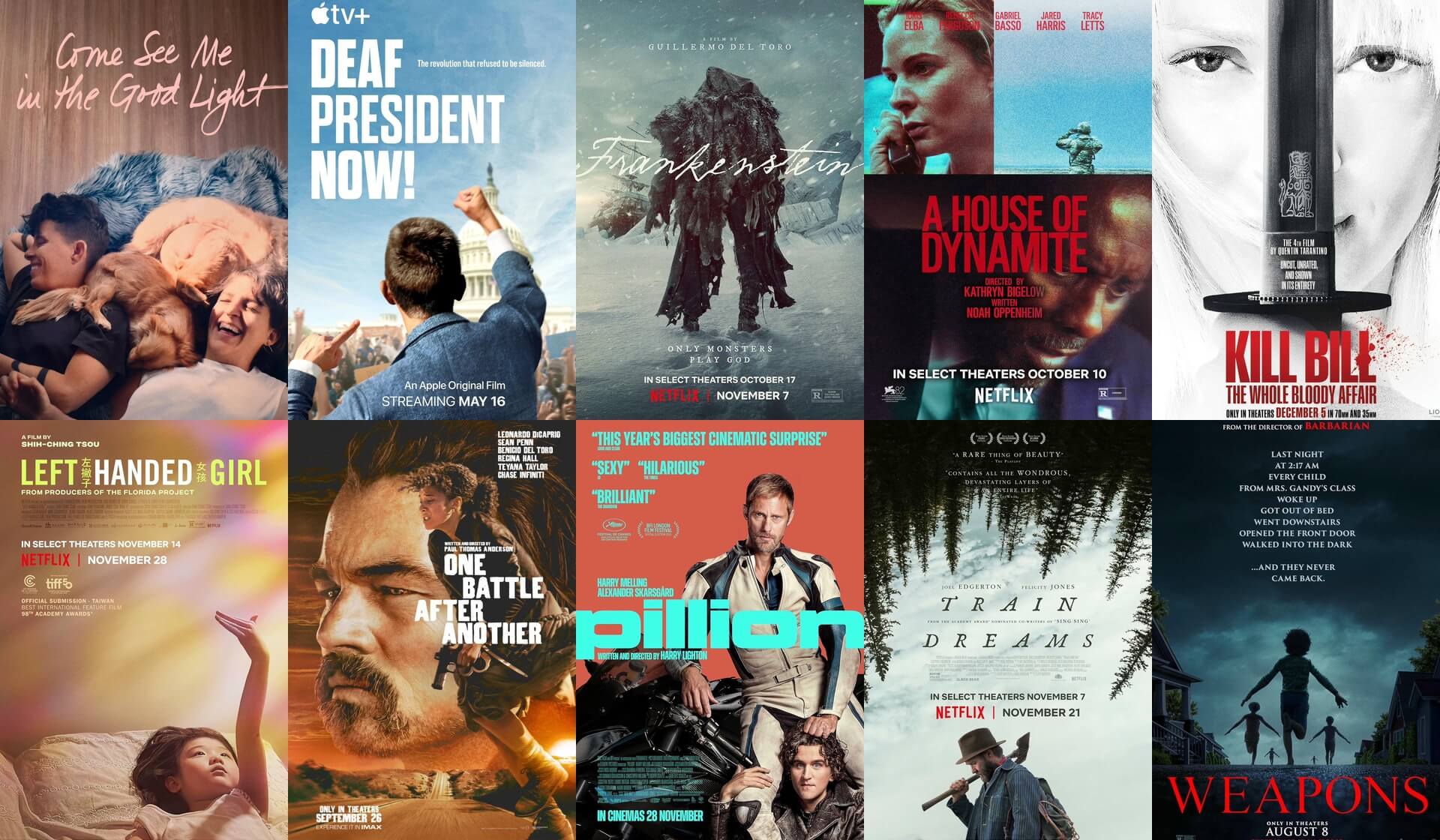
The films that stayed with me in 2025 share a preoccupation with battles – some fought in the streets, others waged quietly across generations, still others buried deep in the self. Directors returned again and again to questions of inheritance: what we pass down to our children, what we demand from our institutions, what we owe the creations we bring into being. Several films found unexpected tenderness in unlikely places – a BDSM relationship built on mutual longing, a terminal diagnosis met with laughter and verse, a solitary laborer’s life rendered in fragments of memory and landscape. Others sounded alarms about the fragility of the world we’ve constructed, reminding us that safety is often an illusion. From sprawling epics shot in rare formats to intimate character studies, these are the films worth seeking out and sitting with.
Come and See Me in the Good Light
Directed by Ryan White
A documentary involving cancer may sound like a hard watch, but Ryan White’s Sundance 2025 Festival Favorite is anything but. Moving and unexpectedly funny, “Come and See Me in the Good Light” follows Colorado Poet Laureate Andrea Gibson and partner Megan Falley as they face Andrea’s terminal ovarian cancer diagnosis. Having spent decades transforming pain into verse, and offering a lifeline for countless listeners navigating identity, love, and loss, Andrea invites us into their intimate moments filled with laughter, grace, and resilience. Beautifully interlaced with Andrea’s poetry, this life-affirming story serves as a reminder to savor the precious minutes we are given, whether in love or in pain.
Deaf President Now!
Directed by Nyle DiMarco and Davis Guggenheim
Directors DiMarco and Guggenheim assemble the key participants – now graying but no less fiery – from a 1988 protest at Gallaudet University when deaf students demanded the appointment of a deaf president to represent the nation’s only deaf university. As participants recount the week-long uprising with disarming humor and hard-won pride, the film’s sound design places viewers in the liminal space between silence and sensation, mirroring the exclusion often experienced by the deaf community. Overlooked by hearing audiences, this protest belongs alongside the lunch counter sit-ins as a defining moment in American civil rights movements – its influence on the Americans with Disabilities Act two years later cements that standing.
Frankenstein
Directed by Guillermo del Toro
Decades in development, “Frankenstein” is Guillermo del Toro’s beautifully lavish take on Mary Shelley’s novel, a meditation on creation, rejection, and the monstrous potential of playing god. Del Toro’s signature visual craft is on full display, with cinematography and production design that render every candlelit interior and snow-swept landscape into a Victorian-like painting. In an age when artificial intelligence forces us to reckon anew with what we create and how we treat it, del Toro finds timely resonance in this 200-year-old story about fear of the other and humanity’s appetite for godhood. A poignant and heartfelt adaptation anchored by Jacob Elordi’s aching performance as The Creature.
A House of Dynamite
Directed by Kathryn Bigelow
Building on her career of taut, pressure-cooker filmmaking (“The Hurt Locker”, “Zero Dark Thirty”), Kathryn Bigelow’s “A House of Dynamite” is her most nerve-shredding work yet. Unfolding as a race against time, the film’s shifting perspectives gradually dismantle any illusion of safety we cling to in the face of nuclear annihilation. What elevates the film beyond pure genre exercise is its thematic ambition – a timely reflection on a world teetering on fault lines threatening to crack open at any provocation. The film lands less as entertainment than as warning, with Bigelow reminding us that we collectively live in a house full of dynamite we refuse to reckon with.
Kill Bill: The Whole Bloody Affair
Directed by Quentin Tarantino
Call it a cheat, but Tarantino’s legendary complete cut of his 20+ year old revenge opus (unleashed in glorious 70mm this year) demanded fresh consideration. Reuniting Volumes 1 and 2 into the singular vision Tarantino always intended, “Kill Bill: The Whole Bloody Affair” follows The Bride (Uma Thurman) as she systematically hunts the assassins who left her for dead. Freed from cliffhanger obligations due to the original’s theatrical distribution, the 2025 cut reframes a crucial plot twist so The Bride and viewer experience it together, deepening the film’s emotional journey. Tarantino’s genre-blending remains as audacious as ever: Shaw Brothers martial arts colliding with spaghetti westerns, anime interludes giving way to Leone standoffs, and Thurman’s performance holding up as one of the great action turns in cinema history.
Left Handed Girl
Directed by Shih-Ching Tsou
Shih-Ching Tsou, filmmaking partner on several Sean Baker films, steps into the director’s chair with a vibrant, multigenerational story set in Taipei. The film centers on five-year-old I-Jing, whose innocent left-handedness – a shameful trait in old customs – becomes a source of family tension. From the adorable I-Jing to her protective teenage sister, disaffected mother, and stubborn grandmother, each woman quietly bears the weight of some societal imperfection. Shot entirely with an iPhone, this deftly edited film with candy-colored cinematography captures the pulsating energy of Taiwan’s night markets and communal living spaces cramped with secrets, as Tsou explores how shame and expectation pass down from generation to generation.
One Battle After Another
Directed by Paul Thomas Anderson
“One Battle After Another” is Paul Thomas Anderson’s most ambitious undertaking yet – a sweeping, unexpectedly funny, and urgently relevant epic operating at peak PTA. The film traces generational cycles of resistance and complacency, asking what compels one era to fight for principles the next takes for granted (or abandons entirely). Anderson weaves immigration, political unrest, the convenient erasure of historical sins, and the creeping advance of fascism into a narrative that feels both timeless and alarmingly of-the-moment. Shot in rare VistaVision, the film is a visual stunner when experienced on large screen formats and a potent reminder that the battles worth fighting are never truly finished – they simply await the next generation willing to take them up.
Pillion
Directed by Harry Lighton
“Pillion” is the kind of film that lingers in your mind long after the credits roll, demanding you sit with its premise. First-time feature director Harry Lighton invites you into the world of BDSM relationships with surprising tenderness and zero sensationalism, crafting an unconventional romance that is equal parts discomforting and deeply humane. Alexander Skarsgård delivers a commanding performance as a dominant seeking genuine connection, while Harry Melling brings a gentle vulnerability to his submissive counterpart – their chemistry built on aching loneliness and the universal need to be seen. Lighton navigates the delicate subject matter with quiet assurance, finding moments of unexpected warmth and humor amid the leather and protocol. If the conditions of this relationship aren’t your cup of tea, consider that these characters’ yearning for acceptance and intimacy should feel just as relevant and vital as your own. A film that asks only for an open mind, and rewards it generously.
Train Dreams
Directed by Clint Bentley
Clint Bentley crafts a poetic meditation on a railroad laborer’s life in the early 20th-century Pacific Northwest, drawing beautiful visual inspiration from Terrence Malick’s work. Joel Edgerton delivers one of the year’s best performances as a man whose life unfolds in fragments of loss, labor, and longing across decades of American frontier transformation. Bentley leans into lyrical impressionism, with memory and landscape bleeding into one another, as Edgerton conveys oceans of grief and wonderment with little more than a weathered glance. The film asks what remains of a life lived mostly in solitude, and answers with images that linger like half-remembered dreams.
Weapons
Directed by Zach Cregger
Zach Cregger’s “Weapons” – a superior follow-up to the excellent “Barbarian” – solidifies Cregger as a master craftsman of elevated horror. “Weapons” burrows into the anxieties festering beneath American suburbia, where manicured lawns and minivans mask something far more sinister. Cregger constructs his nightmare with inventive originality, layering undercurrents of genuine tragedy – the specter of school violence, the erosion of innocence – into a thriller that keeps you guessing. Using a non-linear structure, told from different perspectives, the film builds to a climactic confrontation that delivers one of the year’s most satisfying payoffs. In an era when real-world violence haunts our schools and communities, Cregger transforms that collective dread into something cathartic and deeply unsettling.
Other notable mentions from the year…
- “André is an Idiot” – André Ricciardi turns his own medical procrastination into a hilarious and moving case for getting your colonoscopy.
- “The Chronology of Water” – Kristen Stewart’s directorial debut uses experimental form to mirror the splintered nature of traumatic memory.
- “Sentimental Value” – Lars von Trier offers a Bergman-esque meditation on the father-daughter bond and art’s healing grace.
- “Sinners” – Ryan Coogler’s masterful genre blend fusing Delta blues history with horror to interrogate Black cultural appropriation.